
Executive Summary
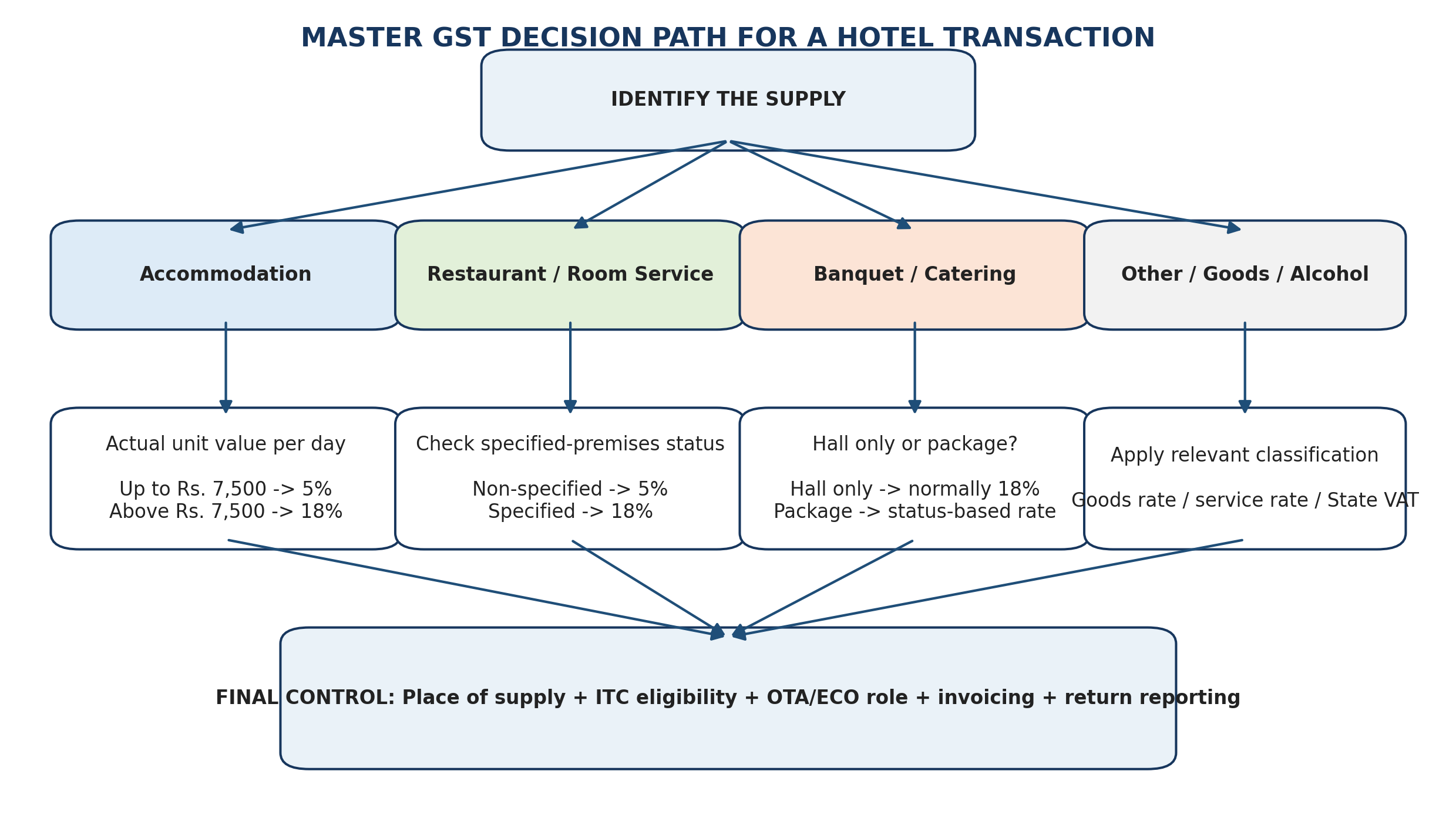
GST for a hotel cannot be determined by selecting one tax rate for the entire property. A single hotel may simultaneously have rooms taxable at 5% without input tax credit, rooms taxable at 18% with input tax credit, restaurant services taxable at 5% or 18%, banquet hall rental taxable at 18%, banquet packages taxable at 5% or 18%, alcoholic liquor outside GST, packaged products taxable at their respective goods rates, and common expenditure requiring proportionate ITC reversal.
The most important planning issue is that becoming a specified premises does not convert every supply of the hotel into an 18% supply. The correct GST treatment must be determined supply-wise, property-wise and, in certain cases, room-wise and asset-wise.
| ROOM VALUE TEST Up to Rs. 7,500: 5% without ITC Above Rs. 7,500: 18% with ITC | PREMISES STATUS Restaurant, room service and banquet rates depend on annual specified-premises status. |
|---|---|
| ITC TEST Classify every expense as eligible, ineligible, common or blocked. | CAPITAL GOODS Common capital credit may continue through the 60-month Rule 43 mechanism. |
GST Dashboard: Rates at a Glance
| Nature of supply | GST rate | ITC position |
|---|---|---|
| Hotel accommodation up to Rs. 7,500 per unit per day | 5% | Not available |
| Hotel accommodation above Rs. 7,500 per unit per day | 18% | Available, subject to conditions |
| Restaurant / room service at non-specified premises | 5% | Not available |
| Restaurant / room service at specified premises | 18% | Available |
| Outdoor catering / catering with function premises at non-specified premises | 5% | Not available |
| Outdoor catering / catering with function premises at specified premises | 18% | Available |
| Hall rental without catering | Normally 18% | Available, subject to conditions |
| Alcoholic liquor for human consumption | Outside GST | State VAT / excise applies |
| Packaged goods independently sold | Applicable goods rate | Subject to normal ITC rules |
Article Roadmap
| Section | What it covers |
|---|---|
| Part I | Hotel accommodation and the Rs. 7,500 unit-value test |
| Part II | Specified-premises status and its annual, property-wise effect |
| Parts III-V | Restaurant, room service, packages, banquets and catering |
| Parts VI-VIII | ITC classification, new-hotel capital expenditure, Rules 42 and 43 |
| Parts IX-XV | Construction, alcohol, OTA/ECO, advances, place of supply, RCM and e-invoicing |
| Final section | Monthly controls, FAQs and management action checklist |
Part I - GST on Hotel Accommodation
1. Current GST rates on accommodation
With effect from 22 September 2025, hotel accommodation is taxable as follows:
| Value of accommodation | GST rate | ITC |
|---|---|---|
| Up to Rs. 7,500 per unit per day or equivalent | 5% | Not available |
| Above Rs. 7,500 per unit per day or equivalent | 18% | Available |
2. Accommodation rate decision flow
3. Meaning of per unit per day
The limit must be examined separately for each accommodation unit and each day. An accommodation unit may include:
- room or suite
- cottage or villa
- tent or houseboat
- serviced accommodation unit
- hostel room or bed, where independently supplied
- any other separately supplied lodging unit
Illustration 1: accommodation below the threshold
| Particulars | Amount |
|---|---|
| Room charges: Rs. 6,000 x 2 nights | Rs. 12,000 |
| GST at 5% | Rs. 600 |
| Total invoice value | Rs. 12,600 |
ITC relating exclusively to this accommodation is not available.
Illustration 2: accommodation above the threshold
| Particulars | Amount |
|---|---|
| Room charges: Rs. 8,000 x 2 nights | Rs. 16,000 |
| GST at 18% | Rs. 2,880 |
| Total invoice value | Rs. 18,880 |
Eligible ITC may be claimed subject to Sections 16 and 17 of the CGST Act.
4. Different rates within the same hotel
| Room category | Actual value per day | GST treatment |
|---|---|---|
| Standard room | Rs. 6,500 | 5% without ITC |
| Deluxe room | Rs. 7,500 | 5% without ITC |
| Executive suite | Rs. 8,000 | 18% with ITC |
| Presidential suite | Rs. 15,000 | 18% with ITC |
The threshold is crossed only where the value is above Rs. 7,500.
5. Can room values be averaged?
Room values should not ordinarily be averaged across different rooms, categories, guests, dates, peak and non-peak periods, or the complete duration of a stay.
6. Seasonal rates, discounts and compulsory charges
Where a room with a published tariff of Rs. 9,000 is genuinely supplied for Rs. 7,000 after a commercial discount, the actual value may be Rs. 7,000 if the discount is legally permissible and properly documented.
- tariff sheets and approved discount policy
- booking confirmation and corporate agreement
- discount authorisation
- OTA statement
- customer invoice and payment record
Artificial division of a compulsory accommodation charge into resort fee, amenity fee, mandatory facility charge, service fee or utility charge should be avoided. A compulsory connected amount may form part of the accommodation value.
7. Accommodation up to Rs. 1,000 is not exempt
The earlier exemption for hotel accommodation valued up to Rs. 1,000 per day was withdrawn with effect from 18 July 2022. Consequently, accommodation charged at Rs. 700, Rs. 800, Rs. 900 or Rs. 1,000 is also taxable and is ordinarily covered by the current 5% rate without ITC.
Part II - Understanding Specified Premises
8. Why specified-premises status matters
Specified-premises status principally determines the GST treatment of restaurant service, room service, outdoor catering and catering supplied with banquet or function premises. It does not automatically determine the GST rate on accommodation.
9. Annual and premises-specific test
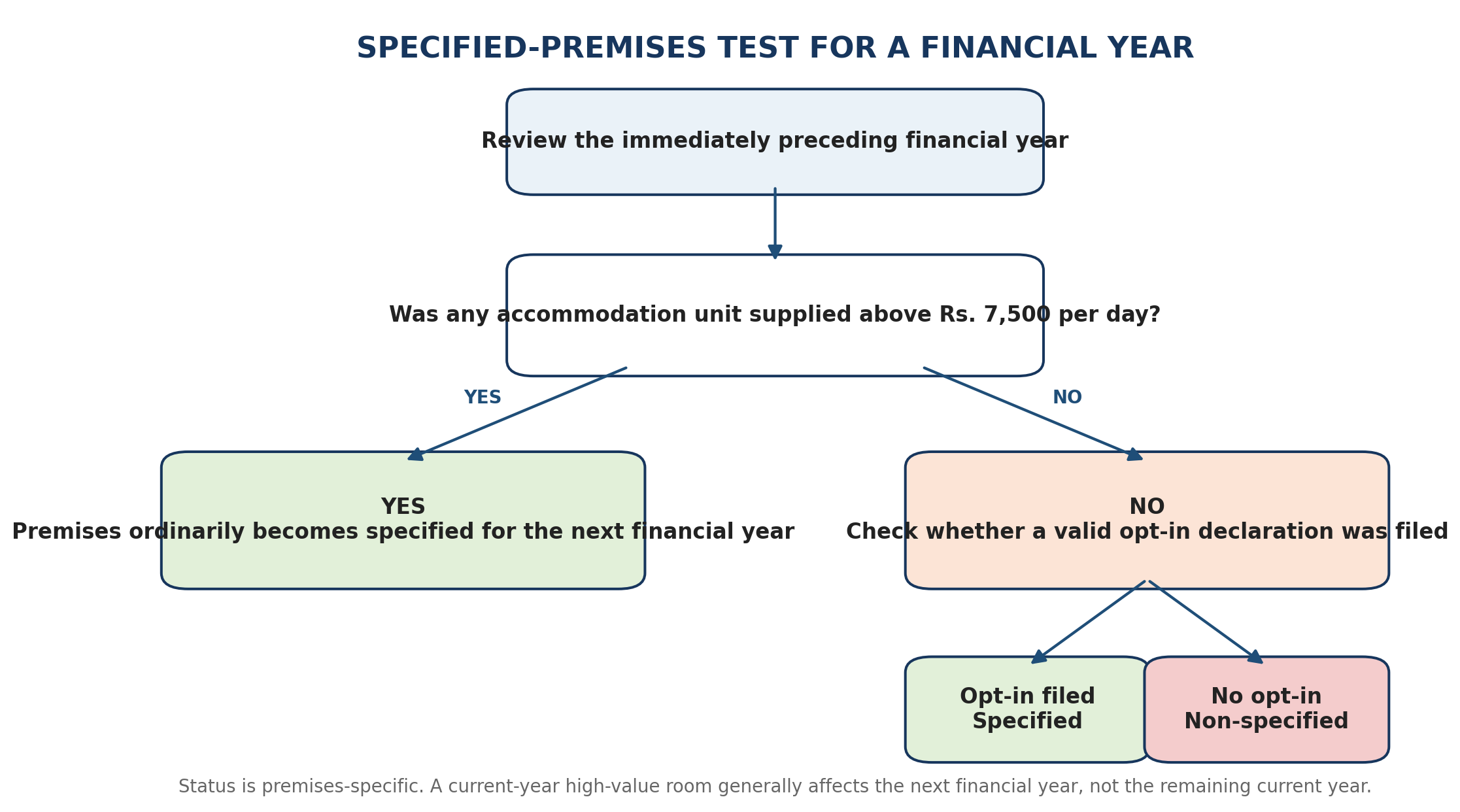
For a financial year, a premises is treated as specified where the supplier provided, during the preceding financial year, any unit of hotel accommodation above Rs. 7,500 per day, or where a valid premises-wise opt-in declaration was filed in the prescribed manner.
10. Illustration: one high-value room
During FY 2025-26, a hotel charged Rs. 6,500 for most rooms but supplied one suite at Rs. 8,000 on a festival date. Since at least one accommodation unit was supplied above Rs. 7,500, the property would ordinarily qualify as a specified premises for FY 2026-27.
11. Current-year high tariff does not immediately change the annual status
| Issue | Treatment |
|---|---|
| One room supplied at Rs. 8,500 during a non-specified financial year | That room is taxable at 18% |
| Restaurant rate for the balance of the same year | Does not automatically change |
| Specified-premises status for the following year | May arise due to the high-value room supply |
12. Multi-property hotel businesses
| Property | Status | Restaurant rate |
|---|---|---|
| Hotel A | Specified premises | 18% with ITC |
| Hotel B | Non-specified premises | 5% without ITC |
| Hotel C | New property with valid opt-in | 18% with ITC |
Separate property-wise controls should be maintained for tariff records, declarations, revenue ledgers, ITC attribution, fixed assets and Rule 42/43 workings.
Part III - GST on Restaurant Services
13. Restaurant rate matrix
| Restaurant supply | GST rate | ITC |
|---|---|---|
| Restaurant at non-specified premises | 5% | Not available |
| Restaurant at specified premises | 18% | Available |
| Takeaway / delivery from non-specified premises | 5% | Not available |
| Restaurant service at specified premises | 18% | Available |
A non-specified restaurant cannot ordinarily choose to charge 18% merely to claim ITC. The 5% entry is a conditional prescribed rate, not a voluntary option.
14. Restaurant illustrations
| Particulars | Non-specified premises | Specified premises |
|---|---|---|
| Food value | Rs. 2,000 | Rs. 2,000 |
| GST | Rs. 100 at 5% | Rs. 360 at 18% |
| Customer payable | Rs. 2,100 | Rs. 2,360 |
| ITC position | Not available | Available subject to conditions |
15. Takeaway and doorstep delivery
Food supplied through takeaway, home delivery, room delivery or a food-delivery platform generally remains restaurant service. The mode of delivery does not, by itself, convert prepared restaurant food into an independent supply of goods.
Part IV - Room Service, Breakfast and Hotel Packages
16. Room service
| Hotel status | GST on room service | ITC |
|---|---|---|
| Non-specified premises | 5% | Not available |
| Specified premises | 18% | Available |
The hotel should maintain separate billing codes for room rent, room-service food, minibar supplies, laundry, spa, transport and other incidental services. Inclusion in one guest bill does not make every item accommodation.
17. Complimentary breakfast
Breakfast included in the room tariff may form part of a composite supply where it is normally bundled with the room, included in a single package, not independently optional and ancillary to accommodation.
Separate taxation should be examined where breakfast is separately priced, optional, independently transferable through coupons, supplied to non-resident guests, or commercially provided as an independent restaurant supply.
18. Composite supply versus mixed supply
| Classification | Test | Tax result |
|---|---|---|
| Composite supply | Supplies are naturally bundled and one is the principal supply | Rate of the principal supply |
| Mixed supply | Independent supplies are combined for one price without natural bundling | Highest applicable rate among components |
| Separate supplies | Each component is independently contracted and priced | Tax each supply separately |
Part V - Banquets, Conferences and Outdoor Catering
19. Banquet rate matrix
| Nature of supply | Non-specified premises | Specified premises |
|---|---|---|
| Restaurant service | 5% without ITC | 18% with ITC |
| Outdoor catering | 5% without ITC | 18% with ITC |
| Catering with banquet premises | 5% without ITC | 18% with ITC |
| Hall-only rental | Normally 18% with ITC | Normally 18% with ITC |
20. Composite banquet package
A banquet package may include the hall, food, serving staff, tables, chairs, housekeeping, sound system, basic decoration, lighting and event coordination.
| Particulars | Non-specified premises | Specified premises |
|---|---|---|
| Package value | Rs. 2,00,000 | Rs. 2,00,000 |
| GST | Rs. 10,000 at 5% | Rs. 36,000 at 18% |
| Total | Rs. 2,10,000 | Rs. 2,36,000 |
| ITC | Not available | Available subject to conditions |
21. Hall-only rental and artificial splitting
Where only a banquet hall, conference room or meeting room is rented without catering, GST is ordinarily payable at 18% and eligible ITC may be available. However, separate invoices for hall and food do not automatically establish separate supplies.
- whether food was compulsory
- whether one agreement covered the complete event
- whether the customer could appoint an independent caterer
- who collected the consideration
- who controlled and was responsible for the arrangement
- whether the supply was commercially offered as one package
22. Independent external caterer
Where the hotel rents only the hall and the customer independently appoints an unrelated caterer, the hotel may ordinarily charge 18% on hall rental while the caterer determines its own GST treatment. Separate contracts, invoices, payment obligations and performance responsibilities should be maintained.
Part VI - The Input Tax Credit Framework
23. ITC heat map
| Credit category | Meaning | Typical hotel example |
|---|---|---|
| Eligible | Directly attributable to eligible 18% supplies | Repairs to a hall rented at 18% |
| Ineligible | Directly attributable to 5% no-ITC supplies | Food ingredients for a 5% restaurant |
| Common | Used for eligible and no-ITC supplies | Audit fee or common hotel software |
| Blocked | Restricted independently by Section 17(5) | Construction of hotel building |
| Non-business | Personal or unrelated use | Promoter personal expenditure |
24. Directly ineligible credit
- food ingredients exclusively used in a 5% restaurant
- OTA commission exclusively relating to 5% accommodation
- toiletries exclusively used in rooms taxed at 5%
- kitchen repairs exclusively relating to a 5% restaurant
- consumables exclusively used for a 5% banquet package
25. Directly eligible credit
- food inputs exclusively used in an 18% restaurant
- repairs relating exclusively to hall rental at 18%
- OTA commission exclusively relating to accommodation taxed at 18%
- professional fees exclusively connected with eligible taxable supplies
- equipment used exclusively for an eligible 18% activity
26. Common and blocked credit
Common expenditure includes audit fees, legal and professional fees, management software, central reservations, common advertising, security and administrative expenditure. Such credit requires proportionate reversal. Construction of the hotel building, civil structures, capitalised civil renovation and other Section 17(5) expenditure may remain permanently blocked.
Part VII - New Hotel Capital Expenditure: The Critical Transition Issue
27. The practical issue
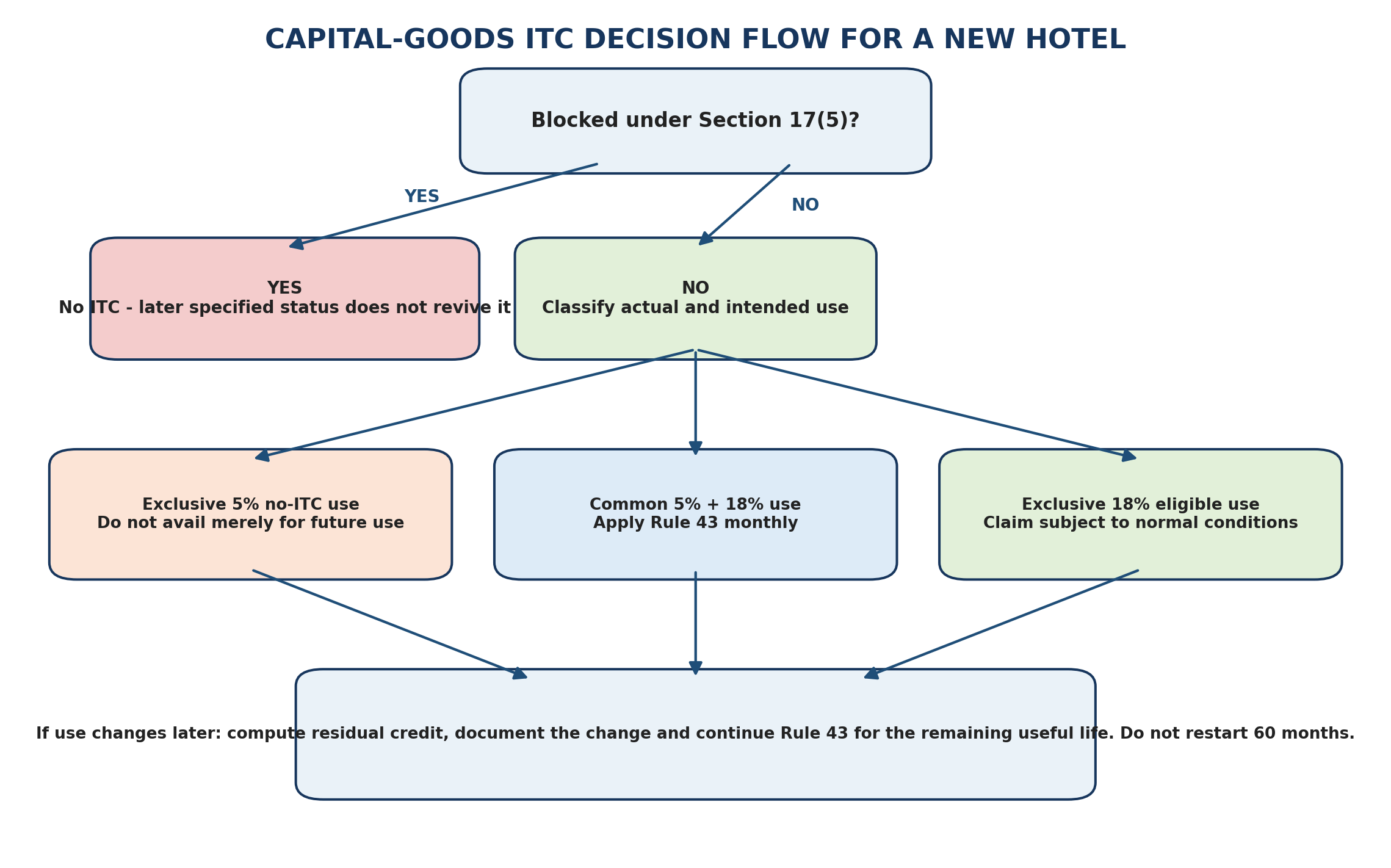
A newly opened hotel may be non-specified in its first financial year and specified from the following year. It may already have incurred substantial GST on restaurant furniture, room furniture, kitchen machinery, laundry equipment, generators, air-conditioning equipment, servers, banquet furniture and other plant and machinery.
28. Capital goods versus immovable property
| Asset category | Examples | General approach |
|---|---|---|
| Movable capital goods | Beds, movable tables, ovens, refrigerators, laundry machinery, computers | Examine actual/intended use and Rule 43 |
| Assets requiring deeper classification | HVAC, lifts, fire systems, water-treatment plants, fixed installations | Examine plant-and-machinery definition and immovability |
| Blocked immovable property | Hotel building, civil structure, capitalised civil interiors | Generally no ITC under Section 17(5) |
29. Asset-wise classification
| Asset use | Illustrative asset | Likely ITC treatment |
|---|---|---|
| Exclusive 5% no-ITC use | Kitchen machinery used only for non-specified restaurant | Do not avail during exclusive no-ITC use |
| Exclusive 18% eligible use | Furniture used only for hall-only rental | Eligible subject to normal conditions |
| Common 5% and 18% use | Generator, central laundry or common server | Rule 43 apportionment |
| Low-tariff room use | Furniture dedicated to rooms up to Rs. 7,500 | Generally ineligible |
| Variable room use | Furniture in rooms supplied below and above Rs. 7,500 | Common-capital treatment may apply |
| Construction / civil work | Hotel building and capitalised civil interior | Generally blocked |
30. Scenario A: capital goods are common from the beginning
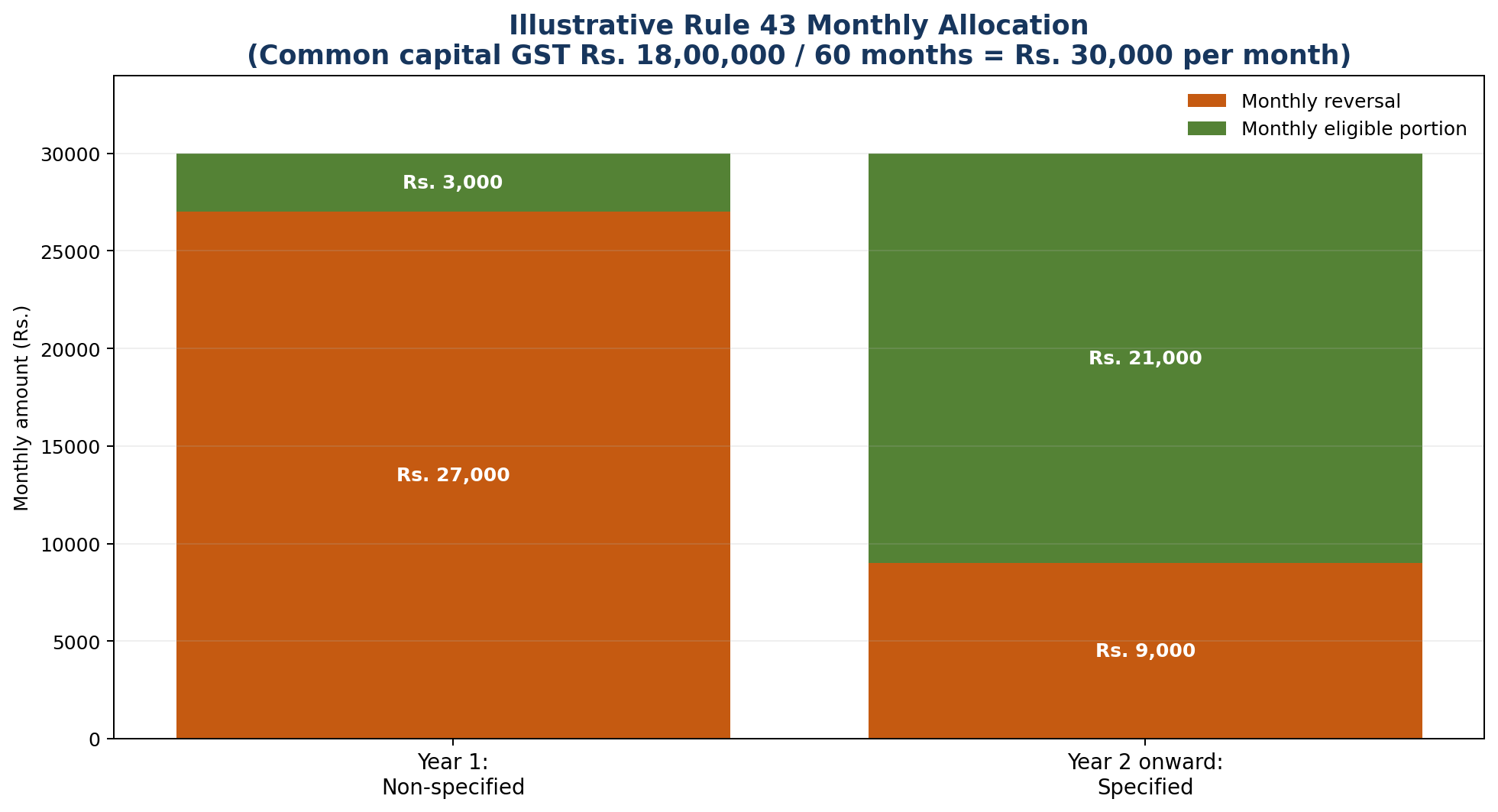
Where future eligible use is definite, genuine and documented, an asset used or intended to be used across the non-specified and specified periods may be evaluated as common capital goods. Subject to the legal conditions, eligible GST may be availed, the useful life is taken as 60 months, and the portion attributable to no-ITC turnover is reversed every month.
31. Rule 43 illustration: before and after becoming specified
| Particulars | Amount |
|---|---|
| Value of common capital goods | Rs. 1,00,00,000 |
| GST paid | Rs. 18,00,000 |
| Useful life for Rule 43 | 60 months |
| Monthly capital credit | Rs. 30,000 |
| Period | No-ITC turnover ratio | Monthly reversal | Monthly eligible portion |
|---|---|---|---|
| Year 1: non-specified | 90% | Rs. 27,000 | Rs. 3,000 |
| Year 2 onward: specified | 30% | Rs. 9,000 | Rs. 21,000 |
32. Scenario B: asset was exclusively used for a 5% no-ITC supply
Where restaurant machinery was genuinely acquired and used exclusively for a restaurant taxed at 5% without ITC, credit should not ordinarily be availed merely to park it in the ledger. If use later changes, the residual-credit and change-in-use provisions must be examined.
| Particulars | Amount |
|---|---|
| GST paid on machinery | Rs. 18,00,000 |
| Purchase date | 15 July 2026 |
| Change to eligible/common use | 1 April 2027 |
| Elapsed quarters or parts | 3 |
| Reduction: 3 x 5% | Rs. 2,70,000 |
| Residual amount for further examination | Rs. 15,30,000 |
The residual amount must thereafter be dealt with under the applicable legal mechanism for the remaining useful life. A material claim should be supported by an invoice-wise legal note and change-in-use evidence.
33. Scenario C: room furniture continues to support 5% accommodation
| Use of room | ITC treatment |
|---|---|
| Room always charged up to Rs. 7,500 | Credit generally unavailable |
| Room always charged above Rs. 7,500 | Credit may be eligible |
| Same room charged below and above Rs. 7,500 | Common capital-goods treatment may apply |
Specified-premises status does not convert low-tariff accommodation into an 18% supply. Accordingly, room furniture may remain partly or fully ineligible even after the restaurant becomes taxable at 18%.
34. Can valid credit remain in the electronic credit ledger?
35. Time limit, intended use and depreciation
The hotel should not postpone all capital-goods decisions until the following year, because the statutory time limit for availing ITC may expire. Capital expenditure should be reviewed at purchase-order, invoice, capitalisation and commencement stages.
Where ITC is claimed on capital goods or plant and machinery, depreciation under the Income-tax Act cannot also be claimed on the same GST component. Any subsequently claimed residual credit should be adjusted in the fixed-asset and depreciation records.
36. Capital-goods control register
| Field | Record to be maintained |
|---|---|
| Invoice and supplier | Supplier name, GSTIN, invoice number and date |
| Asset description and location | Room, restaurant, banquet, utility or common area |
| Nature of asset | Movable, plant, machinery, fixture or civil structure |
| GST and GSTR-2B | Tax amount and month of reflection |
| Initial and intended use | 5%, 18%, common or blocked, with evidence |
| Rule 43 schedule | Start date, monthly amount, ratio and reversal |
| Change in use | Date and residual-credit computation |
| Depreciation | GST component excluded or subsequently adjusted |
| Specified-premises status | Relevant financial-year evidence |
Part VIII - Common Credit Reversal: Worked Example
37. Monthly turnover and input tax
| Supply | Turnover | GST rate | Output GST |
|---|---|---|---|
| Rooms up to Rs. 7,500 | Rs. 10,00,000 | 5% | Rs. 50,000 |
| Restaurant at non-specified premises | Rs. 4,00,000 | 5% | Rs. 20,000 |
| Hall-only rental | Rs. 2,00,000 | 18% | Rs. 36,000 |
| Total | Rs. 16,00,000 | Rs. 1,06,000 |
| Input-tax category | Amount |
|---|---|
| Direct eligible credit relating to hall rental | Rs. 18,000 |
| Direct ineligible credit relating to 5% supplies | Rs. 70,000 |
| Common credit | Rs. 60,000 |
| Final credit position | Amount |
|---|---|
| Direct eligible credit | Rs. 18,000 |
| Eligible common credit | Rs. 7,500 |
| Total usable ITC | Rs. 25,500 |
| Output GST | Rs. 1,06,000 |
| Net cash liability | Rs. 80,500 |
This is a simplified illustration. The actual computation must follow Rules 42 and 43, including annual adjustment and the treatment of capital goods.
Part IX - Construction, Renovation and Interior Expenditure
38. Construction of the hotel building
GST on construction of the hotel building on the taxpayer’s own account is generally blocked under Section 17(5), even though the completed hotel will provide taxable services.
- civil contractor and works-contract charges
- structural work, masonry, flooring and roofing
- capitalised civil interiors
- architect and project-management services directly attributable to construction
- other expenditure forming part of immovable property
39. Plant and machinery and repairs
ITC may be available for qualifying plant and machinery subject to the statutory definition, actual and intended use, attachment to immovable property, and Rule 43. Routine repairs that are not capitalised as construction may be eligible, while major renovation capitalised to the building requires separate Section 17(5) examination.
Part X - Alcohol, Service Charge and Packaged Goods
40. Alcoholic liquor
| Invoice component | Tax treatment |
|---|---|
| Food and non-alcoholic beverages | GST |
| Alcoholic liquor for human consumption | State VAT and excise |
| Service charge attributable to taxable supply | Included in taxable value |
| Other taxable services | GST |
Common expenses of a bar may require ITC reversal because alcohol is a non-taxable supply for GST credit-apportionment purposes.
41. Service charge and tips
A compulsory service charge collected and retained by the hotel ordinarily forms part of consideration and taxable value. The hotel should distinguish compulsory service charge, optional charge, direct employee tips, payroll-distributed tips and amounts collected as agent for employees.
42. Packaged goods and minibar products
Independent sale of sealed snacks, packaged water, confectionery, tobacco products, packaged bakery items, toiletries, souvenirs and minibar products may attract the applicable goods rate. The hotel should examine packaging, HSN, MRP declaration and manner of supply.
Part XI - Online Travel Agents and Food-Delivery Platforms
43. Restaurant supplies through an electronic commerce operator
For restaurant services covered by Section 9(5), the electronic commerce operator pays GST. The restaurant must still include turnover in aggregate turnover, maintain platform-wise reconciliation, account for commission separately and correctly report cancellations and refunds. TCS under Section 52 is not collected on supplies on which the ECO itself pays the entire GST under Section 9(5).
44. Restaurant at specified premises through a platform
Restaurant service at specified premises is generally outside the notified restaurant ECO-tax-payment mechanism. The hotel or restaurant ordinarily remains liable to charge and pay GST at 18%, subject to the actual arrangement.
45. Accommodation through an OTA
- the registered hotel ordinarily pays GST on the accommodation
- the OTA charges GST on commission or service fees
- the OTA may collect TCS where applicable
- the hotel should record gross booking revenue rather than only net settlement
- commission, discounts, cancellations, TCS and refunds must be reconciled separately
| OTA expense relates to | ITC treatment |
|---|---|
| Room taxable at 5% | Generally unavailable |
| Room taxable at 18% | Generally available |
| Common marketing or platform fee | Proportionate reversal |
46. OTA reconciliation format
| Revenue and customer items | Platform and settlement items |
|---|---|
| Gross booking value | Commission and GST on commission |
| Room and meal value | TCS |
| Hotel-funded discount | Cancellation and refund |
| Platform-funded discount | No-show and other adjustments |
| Customer convenience fee | Net bank settlement |
Part XII - Cancellation, Advances and Deposits
47. Cancellation and no-show charges
| Underlying booking | Cancellation amount | GST treatment |
|---|---|---|
| Room booked at Rs. 6,000 | Rs. 1,500 | 5% = Rs. 75 |
| Room booked at Rs. 9,000 | Rs. 2,000 | 18% = Rs. 360 |
Cancellation charges generally follow the GST treatment of the underlying intended supply. Banquet and event forfeitures should similarly be examined with reference to the intended principal supply and the contract.
48. Advances and double-tax risk
Hotels should separately track room-booking advances, wedding deposits, banquet advances, corporate deposits, adjustments, cancellations, refunds and amounts forfeited.
49. Security deposits
A genuinely refundable security deposit is generally not consideration at the time of receipt. GST implications arise when the deposit is adjusted against accommodation, food, banquet services, damage, cancellation or another contractual consideration.
Part XIII - Place of Supply
50. Hotel accommodation
| Hotel location | Customer GSTIN | Correct tax |
|---|---|---|
| Gujarat | Maharashtra | CGST + Gujarat SGST |
The hotel should not charge IGST merely because the customer is registered in another State. Commercial difficulty in claiming the destination State SGST does not alter the statutory place of supply.
51. Restaurant, catering and foreign guests
The place of supply of restaurant and catering services is generally where the service is actually performed. Accommodation supplied in India to a foreign guest is not an export merely because the guest is non-resident, payment is received in foreign currency or an overseas agent arranged the booking.
52. Supplies to SEZ
Zero-rating should not be applied merely because the customer provides an SEZ GSTIN. The hotel should verify the Letter of Approval, authorised operations, place of supply, invoice particulars, endorsement and LUT or tax-payment route.
Part XIV - Reverse Charge Mechanism
53. Common RCM transactions
- legal services from advocates
- director services, where applicable
- goods transport agency services
- specified security services
- specified renting of motor vehicles
- sponsorship services
- import of services
- notified government services and commercial-property renting transactions
RCM tax is generally paid in cash. The resulting ITC may still require reversal where the inward supply supports 5% no-ITC activities.
Part XV - E-Invoicing, Registration and Composition
54. E-invoicing
E-invoicing generally applies where aggregate turnover has crossed the notified threshold of Rs. 5 crore in any relevant preceding financial year, subject to exclusions. It ordinarily covers B2B invoices, exports, SEZ supplies, debit notes and credit notes, but not normal B2C guest invoices.
Hotels should integrate the IRP with property-management software, banquet and corporate billing, restaurant POS, credit-note processing and accounting software.
55. Registration and composition levy
Registration depends upon aggregate turnover, State threshold, compulsory-registration provisions, inter-State supplies, ECO transactions and Section 9(5). Eligible small restaurants may consider composition levy, but because a normal restaurant outside specified premises is already taxed at 5% without ITC, composition may offer compliance simplicity rather than a rate advantage.
Part XVI - Monthly GST Control Dashboard
56. Revenue reconciliation
- property-management-system revenue
- restaurant POS and room service
- banquet, spa and laundry systems
- OTA and food-delivery statements
- e-invoices and general ledger
- GSTR-1 and GSTR-3B
57. Rate reconciliation
| 5% / no-ITC categories | 18% / eligible categories | Other categories |
|---|---|---|
| Rooms up to Rs. 7,500 | Rooms above Rs. 7,500 | Alcohol turnover |
| Non-specified restaurant | Specified restaurant | Packaged goods |
| 5% banquet package | Hall-only rental / 18% banquet | Cancellations and advances |
58. ITC reconciliation
- purchase register and GSTR-2B
- direct eligible and direct ineligible credit
- common and blocked credit
- Rule 42 and Rule 43 reversals
- RCM credit and vendor-payment compliance
- capital-goods register and depreciation records
- electronic credit ledger
59. Annual specified-premises review
- Check whether any accommodation unit exceeded Rs. 7,500 in the preceding year.
- Review opt-in or opt-out declarations property-wise.
- Update restaurant and banquet billing codes for the new financial year.
- Review capital-goods Rule 43 schedules and expected turnover mix.
- Document the tariff and ITC strategy before the financial year begins.
Frequently Asked Questions
1. Can a hotel charge 18% on a room below Rs. 7,500 to claim ITC?
No. Accommodation up to Rs. 7,500 is taxable at 5% without ITC.
2. Can a non-specified restaurant voluntarily charge 18%?
Ordinarily no. The 5% rate without ITC is a conditional prescribed rate.
3. Does one high-value room make the hotel specified?
A room supplied above Rs. 7,500 in the preceding financial year may cause the property to become specified in the following financial year.
4. Does specified-premises status make every room taxable at 18%?
No. Rooms up to Rs. 7,500 continue to be taxable at 5%.
5. Is room service taxed at the room rate?
Ordinarily no. Room service is treated as restaurant service.
6. Is complimentary breakfast always taxed separately?
No. Where naturally bundled with accommodation, it may follow the accommodation supply.
7. Is hall rental always taxable at 18%?
Hall-only rental is ordinarily taxable at 18%. A hall-and-catering package may be taxable at 5% or 18%, depending upon premises status.
8. Can construction ITC be claimed after the hotel becomes specified?
No. Credit independently blocked under Section 17(5) does not become available merely because the hotel becomes specified.
9. Can valid capital-goods credit remain in the electronic credit ledger?
Yes, where it has been validly availed and the required Rule 43 reversals are made.
10. Can the hotel claim the entire furniture credit in the second year?
Not automatically. The credit depends upon whether the furniture supports 5%, 18%, common or blocked activities.
11. Does room furniture become fully eligible once the hotel becomes specified?
No. Room furniture relating to rooms up to Rs. 7,500 may remain ineligible or require proportionate reversal.
12. Is ITC available on restaurant ingredients?
At 5%, ITC is not available. At an 18% restaurant in specified premises, eligible credit may be available.
13. Is alcohol subject to GST?
No. State VAT and excise provisions continue to apply.
14. Who pays GST on food supplied through an app?
For restaurant supplies covered by Section 9(5), the ECO pays GST.
15. Who pays GST on accommodation booked through an OTA?
The registered hotel ordinarily pays GST on accommodation. The OTA charges GST on commission and may collect TCS.
16. Are cancellation charges taxable?
Yes. They generally follow the tax treatment of the intended principal supply.
17. Can IGST be charged because the customer has an out-of-State GSTIN?
Not for hotel accommodation. The place of supply is the location of the hotel.
18. Can depreciation be claimed on GST for which ITC is claimed?
No. Double benefit is not permitted.
19. Does valid ITC lapse at the end of the financial year?
No. Validly availed credit does not lapse merely because the financial year changes.
20. What is the most important control for a new hotel?
Classify capital expenditure before claiming ITC, with separate identification of eligible, no-ITC, common and blocked assets.
Management Action Checklist
| Control area | Action required |
|---|---|
| Room billing | Configure separate 5% and 18% room codes |
| Specified premises | Determine status property-wise every year |
| Restaurant billing | Configure 5% or 18% based on premises status |
| Banquet billing | Separate hall-only and genuine composite packages |
| Purchase accounting | Tag each invoice as eligible, ineligible, common or blocked |
| Capital goods | Maintain a detailed 60-month Rule 43 register |
| Depreciation | Exclude or adjust GST claimed as ITC |
| OTA | Reconcile gross bookings, commission, TCS and settlement |
| Alcohol | Maintain separate GST and State VAT records |
| Advances | Link advance tax with final invoice adjustment |
| E-invoicing | Generate IRN within the applicable reporting period |
| Monthly review | Reconcile PMS, POS, books and GST returns |
| Annual review | Reassess specified-premises status and ITC strategy |
Conclusion
GST compliance for hotels and restaurants is not merely a question of applying 5% or 18%. The correct treatment depends upon room value, premises status, the nature of each restaurant or banquet supply, composite-supply principles, asset use, place of supply, platform arrangements and internal accounting controls.
For a new hotel, GST planning should begin before the first capital purchase is made. A delayed review can result in loss of eligible ITC, incorrect credit availment, excess reversal, missed time limits, depreciation mismatch and avoidable litigation.
Key Statutory References
1. Notification No. 11/2017-Central Tax (Rate), dated 28 June 2017
2. Notification No. 05/2025-Central Tax (Rate), dated 16 January 2025
3. Notification No. 15/2025-Central Tax (Rate), dated 17 September 2025
4. CGST Act - Sections 16, 17 and 18
5. CGST Rules - Rules 40, 42 and 43
6. Circular No. 164/20/2021-GST, dated 6 October 2021
7. Circular No. 167/23/2021-GST, dated 17 December 2021
8. Circular No. 178/10/2022-GST, dated 3 August 2022
9. Notification No. 10/2023-Central Tax, dated 10 May 2023